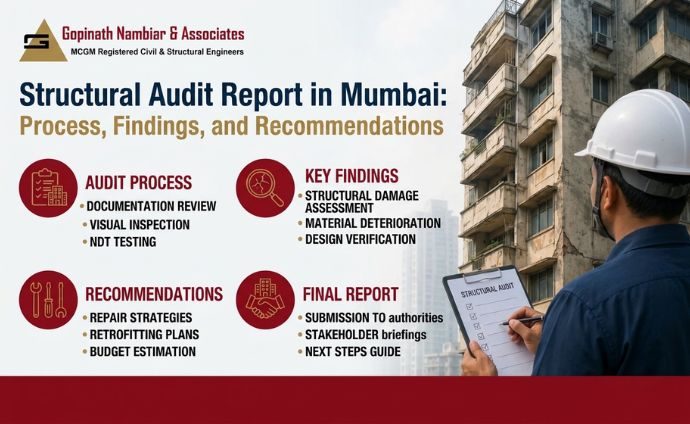

Concrete structures should be inspected periodically to ensure their strength, durability and safety. Buildings, bridges, commercial complexes, and residential towers in a city like Mumbai have problems such as moisture exposure, corrosion, ageing, heavy usage, etc. Knowing of defects in the structure before they become apparent can enable the property owner and engineer to plan for appropriate repairs.
Concrete testing in Mumbai is a non-destructive process that is used to evaluate the condition of the concrete. These tests are used to determine possible weaknesses, to inspect for cracks and assess the quality of concrete prior to taking any further steps.
What is Non-Destructive Testing of Concrete?
NDT is a specialized technique that is employed to inspect concrete without cutting away large sections or disrupting other structural elements. Engineers use Non-Destructive Testing of Concrete techniques to determine the quality of concrete, identify potential defects, and investigate concrete deterioration.
NDT can be applied on newly built buildings, aging residential societies, commercial buildings, industrial plants & infrastructure projects.
But no single test can detect all issues or make a comprehensive evaluation of structural safety. Engineers frequently use several of these techniques and may suggest further tests if they are unsure.
What are the importance of Concrete NDT in Mumbai?
The high humidity in Mumbai, along with monsoon rains and proximity to the sea can lead to moisture infiltration and reinforcement corrosion. Deterioration can also occur in older structures as a result of poor maintenance, water leakage and exposure to the environment for an extended period of time.
Concrete testing can help to identify potential problems before they can become more serious.
Key benefits include:
- Detection of early defects: Any region that might have cracks, voids or honeycombing.
- Structural assessment: Facilitate investigations to existing buildings.
- Maintenance planning: Assists engineers to prioritize maintenance/repair/rehabilitation.
- Quality control: Check for the uniformity of the concrete and check for any potential construction issues.
- Minimized disruption: Investigate a variety of areas with limited salvage or demolition.
Always consider NDT findings with visual inspection, structural drawings, conditions on site, and history of building maintenance.
Common Methods of Non-Destructive Testing of Concrete
1. Rebound Hammer Test
Rebound hammer test is an evaluation of the surface hardness of concrete. A hammer is placed on the surface under a spring load and by measuring the bounce, information about the surface can be obtained.
This approach is used by engineers to evaluate the quality of concrete in various zones and determine the need for further testing in some zones.
It's a relatively fast and simple test to do for a preliminary evaluation. The readings may be affected by surface moisture, carbonation, age of concrete and other factors, however. Does not directly measure compressive strength.
2. Ultrasonic Pulse Velocity Test
Ultrasonic Pulse Velocity (UPV) test is a test that determines the velocity of an ultrasonic pulse through the concrete.
Variations in pulse velocity can be used to determine the quality of the concrete and to get clues as to potential cracks, voids or poorly compacted sections of the concrete.
UPV testing can be used for the study of columns, beams, slabs and other concrete structures. Results are dependent on moisture content, the composition of the concrete and the arrangement of testing equipment.
Engineers can use a UPV test to get a more accurate measurement if they use a rebound hammer reading or other appropriate tests.
3. Half-Cell Potential Test
Half cell potential testing is used to determine the risk of corrosion for reinforcing steel in concrete.
It is especially applicable to buildings subject to moisture and/or chloride contamination or coastal environments. It can be useful in determining potential locations for the problems of reinforcement corrosion.
The test does not however reflect the actual steel loss but rather a corrosion potential. Further investigations might be required by engineers to establish the condition of the corrosion and to suggest repairs.
5. Programmed Concrete Structure and Physical Property Detection
A rebar locator, cover meter, is used to locate rebar and to estimate the thickness of concrete covering the rebar.
This information may be helpful when examining structural components, confirming reinforcement location, or for drilling and repairing.
The other investigations that may damage the reinforcement can be avoided because of rebar detection.
5. Concrete Core Testing
Concrete core is a process that enlists the removal of a small cylinder from a structural component to be examined in a lab.
Core testing is a less destructive method than fully non-destructive methods, in that there is some damage to the area. It can be, however, useful if it is conducted and interpreted properly for information on in-place compressive strength of concrete.
The core test may be recommended by the engineer as a supplement to non-destructive testing where such testing is inconclusive or where it is desirable to have a direct measurement of the strength of the concrete.
When is Concrete NDT appropriate?
If you see any of the following signs, it's time to call a professional concrete expert:
- Cracks that are forming in beams, columns, slabs or walls.
- Breaking, flaking and showing of reinforcement in concrete surfaces.
- Recurring dampness or rust stains.
- Leakage of water in structural components.
- The deterioration that can be seen on an older building.
- Confidence in the concrete's quality during the construction/renovation process.
Testing may also be recommended prior to major property renovations, property rehabilitation, or changes in the intended use of a building.
Note: Cracks and structural movement (exposed reinforcement) must be properly evaluated by a qualified structural engineer in a timely manner. It is not possible to determine a building is safe to use based on NDT alone.
How Does the Concrete NDT Process Work?
The first step to a typical assessment is a site inspection. The engineer examines the visible defects, is reading structural drawings and examining the purpose of the investigation.
Then, appropriate test methods are chosen to suit the structure and its accessibility. Technicians perform the tests, take measurements and determine if additional testing is warranted.
The results are then analysed in conjunction with relevant engineering data. Test site locations, test readings, observations, limitations and recommendations for further testing or repair may be included in a report.
Concrete testing procedures in India must be carried out in accordance with the relevant section of the current requirements of the Bureau of Indian Standards, including IS 516 series.
Conclusion
NDT testing of concrete in Mumbai helps in the inspection, maintenance, and rehabilitation of buildings and infrastructure. Rebound hammer testing, UPV, half-cell potential measurement, and rebar detection methods are helpful to obtain data regarding the quality of concrete and potential deterioration.
The selection of the correct testing methods will be dependent on the structure, concerns found on the inspection, and the information that the engineer requires. When test results are integrated with other structural information from a professional, it enables property owners to make well-informed decisions regarding maintenance and repairs.
For concrete inspection, please contact a qualified structural engineer or testing laboratory to decide which method(s) will be appropriate for your project.